






 Pay in 3 interest-free installments


Laying laminate flooring is relatively straightforward compared to other materials, but when installing your materials over a concrete subfloor, it’s essential to take care to avoid damage. Our guide will cover everything you need to know when laying laminate flooring on concrete, from tips for achieving a professional finish to advice on preparing your boards before installation. Once you’re done reading, you should hopefully be an expert on concrete subfloors and laminate installation.
Can you install laminate on concrete?
Laminate flooring can be installed on a concrete subfloor, but as with any flooring material, you need to take appropriate steps to prepare your floor before laying them. This means cleaning and levelling your subfloor and applying an underlay for extra protection.
Since concrete is a rigid surface, incorrect installation can damage your flooring, as the impact between your concrete and laminate can cause warping and cracks. The key is to cushion your material with an appropriate underlay and to form a tight bond that won’t come loose with repeated use.
Preparing to lay laminate flooring on concrete
Before the installation process can begin, let your materials acclimate. Leave your laminate boards in your chosen room for 24-48 hours, with all packaging removed, before you start laying your laminate. This allows your boards to adapt to the room’s atmosphere, contracting or expanding to suit the temperature and moisture levels. Without acclimation, your materials will change size once they’re secured in place, leading to gaps, cracks, and warping.
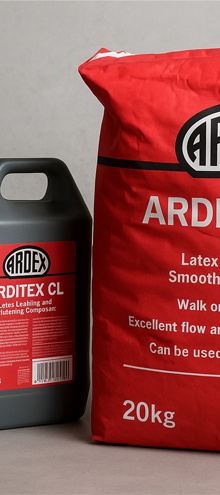
You’ll also need to thoroughly clean your concrete subfloor and ensure it is completely level. This can be done by sweeping and vacuuming any loose debris, then applying a self-levelling compound with a trowel, allowing it to settle into a flat surface.
Once your subfloor is prepared, an underlay is needed to cushion your laminate against its surface. If your underlay does not feature a moisture barrier, you will need to install one separately to prevent water and mould damage. Make sure your underlay is cut to the required size, and check that your sheets overlap as per the manufacturer’s instructions.
How to install laminate flooring on concrete
Now that your subfloor is prepared, you can start to install your laminate flooring. This process will vary slightly depending on whether you use click-lock or glue-down laminate, but the method is broadly similar. Here’s what you need to install laminate on concrete:
- Laminate flooring
- Measuring tape
- Pencil
- T-square
- Saw
- Rubber mallet
- Tapping block
- Flooring adhesive (for glue-down floors)
Once you have all of these on hand, you can begin the process of installing your boards on your concrete subfloor:
- Measure the dimensions of your room and cut your laminate to the appropriate size using a saw. Remember to use spacers to leave an expansion gap around the edges of your floor.
- If you’re using adhesive in your installation, apply it evenly to your subfloor and allow it to cure before installing your laminate.
- Lay your first row of planks by measuring the width of your room, placing spacers, and installing your first board to lay parallel to the wall. Continue laying your planks until the width of your room is covered, making sure each plank is tightly joined by tapping with a rubber mallet.
- Repeat this process row-by-row for the rest of your room, ensuring you stagger your joints for security and a professional finish.
- When laying your final row, cut your laminate to size appropriately to remove excess material. You can then add a skirting board to the edges of your room, or a transition strip if moving from one material to another.
Different laying patterns may require more steps during installation. You can read our guide to installing herringbone laminate flooring for more information on laying parquet boards, as this process differs from laying regular planks.
Dos and don’ts for laying laminate on concrete
To make sure you nail your laminate installation, there are a few helpful tips to keep in mind for the most professional look possible, as well as some common pitfalls to avoid. Here’s our advice on laying your floors perfectly:
Do:
- Measure your flooring as accurately as possible; this will help reduce the risk of future damage. Try measuring multiple times before you cut your boards to ensure you have the correct dimensions.
- Choose an appropriate underlay to suit your needs. Different underlay materials have their own properties, such as varying sound-dampening levels, moisture resistance, cushioning, and more.
- Regularly clean your laminate to prevent damage and keep your materials looking their best.
Don’t:
- Rush to install your laminate without taking appropriate measures beforehand. Your subfloor needs to be well-prepared, your laminate needs to acclimate, and you need to have all the required tools and materials at your disposal.
- Lay your flooring before your adhesive has had time to cure. This will affect the stability of your laminate and will risk future damage.
- Install your flooring using the incorrect system. You should always check whether you’re using glue-down or click laminate before installation, as one method requires adhesive, while the other can be floated.
Conclusion
While concrete subfloors can be an intimidating obstacle when laying your floors, they pose no problem if you take appropriate care during installation. If you choose an effective subfloor and lay your laminate effectively, you’ll be able to enjoy years of comfortable laminate flooring without risking damage.
Still looking for more laminate advice? Our blog has plenty of articles to answer all your questions, from our laminate buying guide to our tips on finding the right laminate thickness.